What happened on 5 June 2026
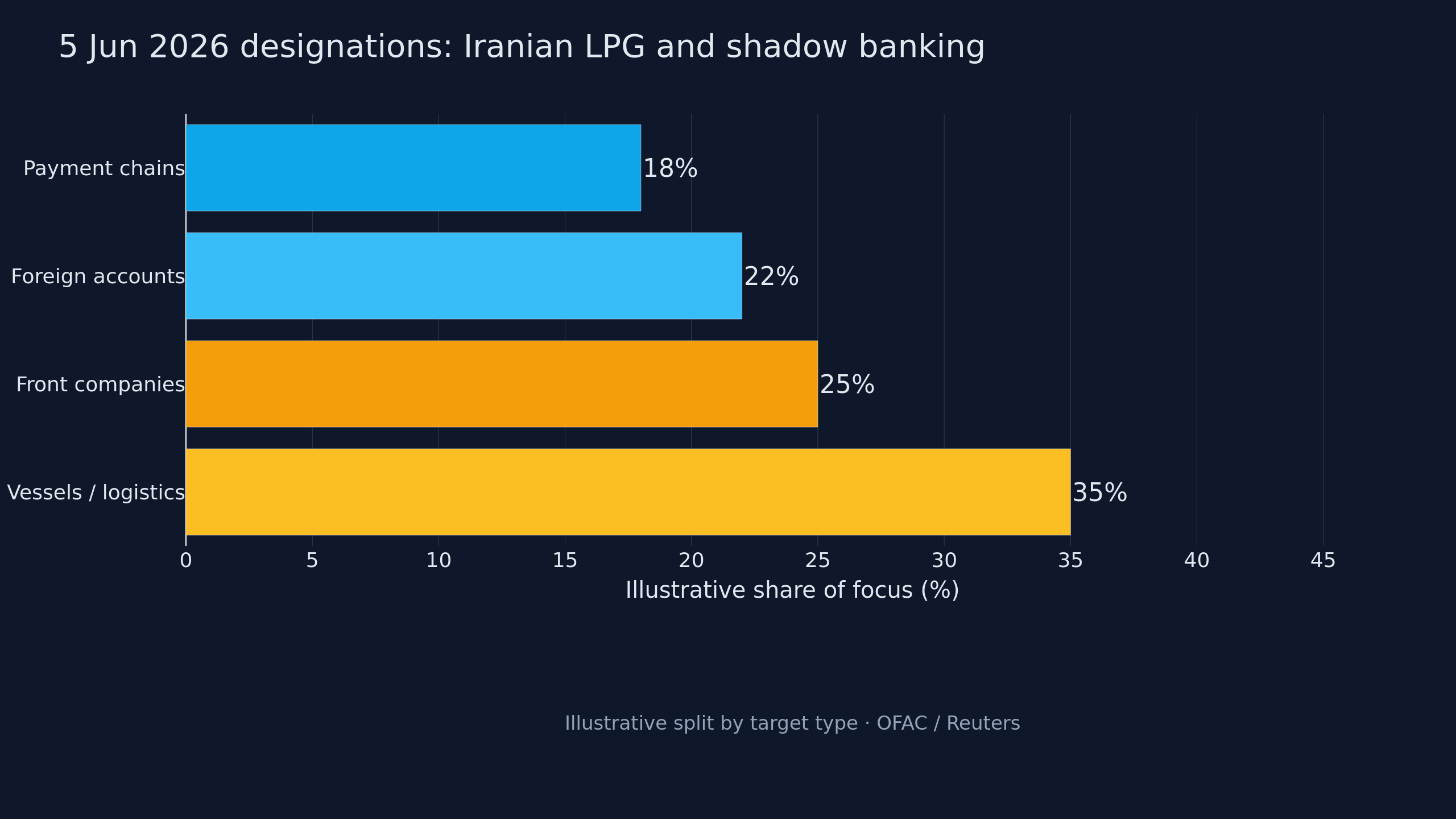
The US Department of the Treasury, through OFAC, issued on 5 June 2026 the release titled «Economic Fury Targets Iranian LPG Smuggling and Shadow Banking Networks» (reference sb0524). This is not market rumour: it is an official sanctions action with related designations logged the same day. Reuters reported it on 5 June as well, stating that Treasury sanctioned a network allegedly smuggling Iranian LPG while presenting it as Omani LPG into Asia, using front companies, foreign accounts and shadow-fleet vessels.
Two fronts: disguised energy and opaque finance
The measure combines two vectors that often appear together in recent Iran sanctions. First, liquefied petroleum gas (LPG) smuggling: cargoes that try to evade controls by shifting documented origin or routing through third countries. Second, shadow banking networks: structures that move payments outside transparent banking to sustain sanctioned trade. OFAC frames the action as part of the «Economic Fury» campaign against revenue Iran would earn from restricted exports.
Context: shadow banking was already on the radar
Focus on shadow banking did not start on 5 June. Treasury had already targeted opaque banking networks linked to Iran on 28 April, 1 May and 19 May 2026. What is new in June is the explicit pairing with LPG smuggling and the detailed Oman–Asia narrative. For compliance teams, the signal is clear: if you were tracking May designations, you need another pass on counterparties, shipping routes and energy payment flows.
How the scheme is described (official and Reuters reading)
In Treasury and financial press accounts, the circuit has several layers: Iranian LPG production or loading, documentation or sale as Omani origin, transport on opaque fleet tonnage and settlement through accounts and companies in intermediary jurisdictions before reaching Asian buyers. You do not need to be a sanctions lawyer to see the risk: any link — broker, charterer, correspondent bank, insurer, inspector — can be exposed without strong enhanced due diligence.
Chart: Treasury escalation in 2026
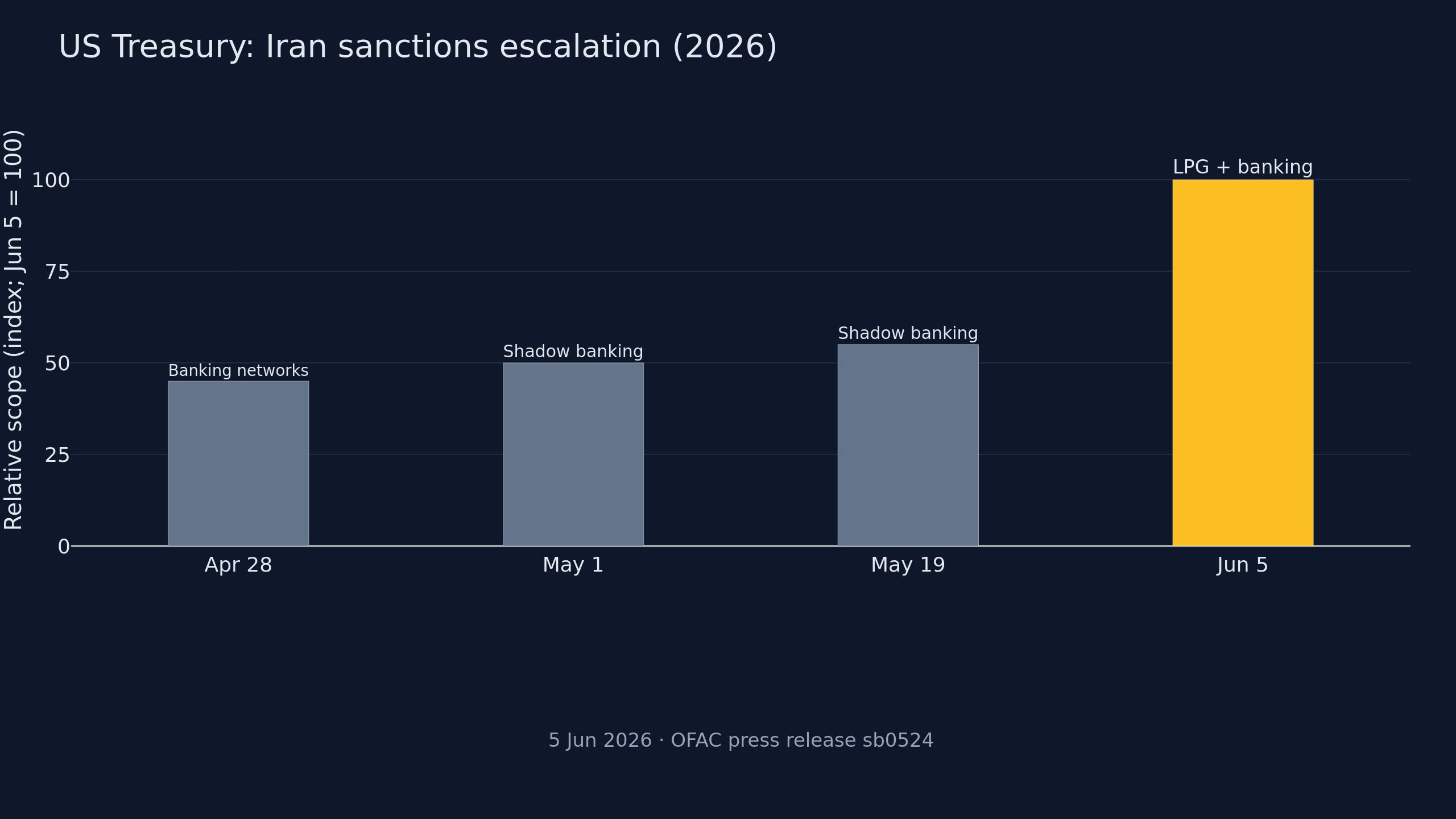
Chart: the two fronts of the 5 June action
What it means for shippers, traders and banks
For LPG shippers and operators, scrutiny rises on vessel history, flag changes, STS transfers and certificates of origin. For energy traders, tracing matters not only for the cargo but for the ultimate payment beneficiary. For banks and payment fintechs, designations reinforce the need to spot split payments, bridge accounts and newly incorporated entities on Gulf–Asia routes. A «commercially normal» deal can become untouchable if a participant lands on the SDN list.
OFAC sanctions: practical effect
OFAC designations typically mean blocked assets under US jurisdiction and transaction prohibitions for US persons and entities, plus secondary risk for international banks that use dollars or maintain US correspondent relationships. In practice, many institutions apply a stricter standard than the legal minimum to keep access to the US financial system.
Asia as destination: why it matters commercially
That the scheme targets Asia is not incidental: much of global LPG demand and seaborne energy trade sits there. For importers, distributors and terminals, the question is not only «where does the gas come from?» but «can I prove chain of custody and origin to a bank or customs authority?». In a wider sanctions environment, weak documentation becomes a cost: holds, bank rejections or retroactive review.
Not a tax reform, but it reshapes your risk map
This story does not change income tax or VAT rates, but it does shift the risk map for anyone invoicing in foreign trade, logistics and financial services. If your business touches energy, chartering or cross-border payments on the Persian Gulf – Strait of Hormuz – Asia corridor, review contracts, compliance clauses and insurance. TaxRadar covers it because sanctions ultimately reshape cash flows, pricing and effective tax residency for operators forced to relocate or restructure.
Conclusion: official action, not speculation
On 5 June 2026 US Treasury crossed another threshold: from pursuing mainly opaque finance networks to explicitly naming Iranian LPG smuggling disguised as Omani, with shadow-fleet and shadow-banking elements in the same package. If you operate in this space, treat compliance and international tax planning as one risk bundle. Primary source: U.S. Department of the Treasury / OFAC — press release sb0524 (5 Jun 2026).