What was published and how to respond
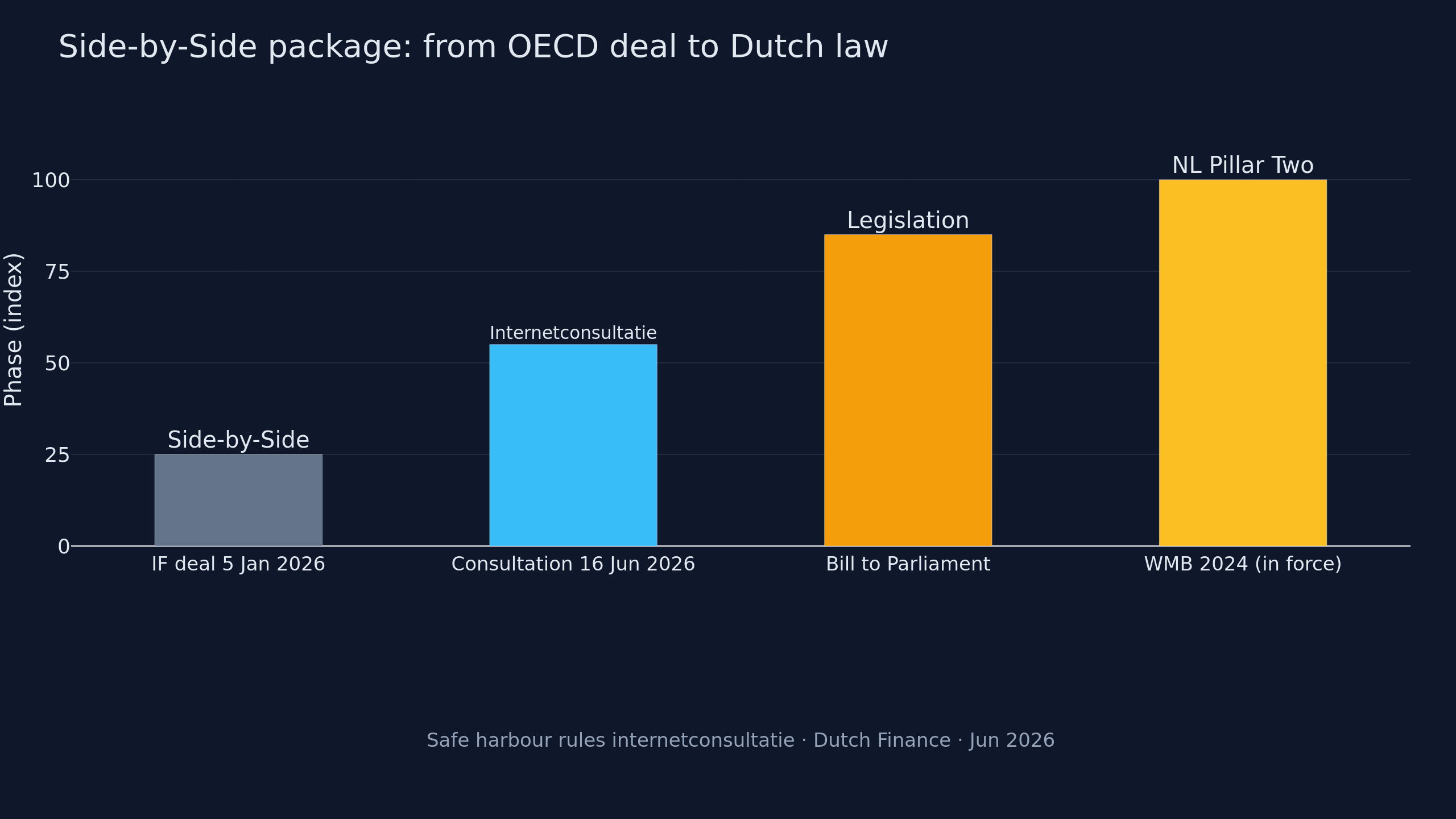
On 16 June 2026 the Dutch Ministry of Finance (Financiën) opened an internet consultation on the Draft Bill on safe harbour rules under the Minimum Tax Act 2024. It includes draft legislation and an article-by-article explanatory note. Responses are submitted on the official platform internetconsultatie.nl/veiligehavenregelswmb2024. The consultation is open to businesses and advisers.
Context: Side-by-Side deal of 5 January 2026
On 5 January 2026 the OECD Inclusive Framework agreed the Side-by-Side package for the global minimum tax (Pillar Two). It allows certain tax systems to be treated as equivalent to Pillar Two under strict conditions, with simplifications and improved treatment of substance-linked incentives. The Netherlands already has the Minimum Tax Act 2024 (WMB 2024) in force since 31 December 2023, implementing the EU 15% minimum tax directive for groups with revenue ≥ €750 million.
What the safe harbour rules do
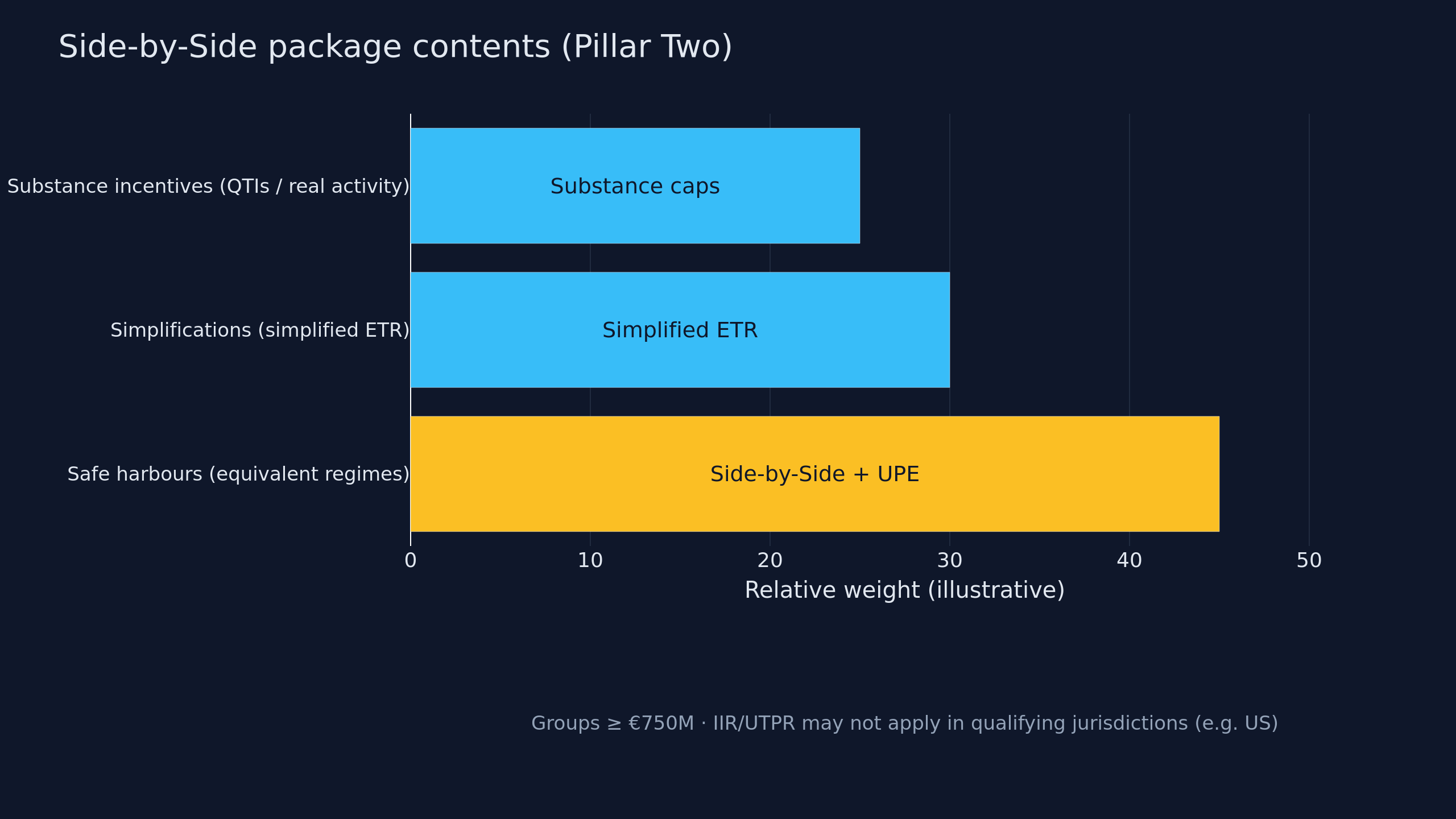
The draft bill implements the main safe harbour tracks: the Side-by-Side Safe Harbour (groups with a UPE in a qualifying jurisdiction: no IIR/UTPR on their profits where the local regime is equivalent) and the UPE Safe Harbour. It also covers the permanent Simplified ETR Safe Harbour and QTIs (substance-based tax incentives with caps tied to payroll or tangible assets).
Chart: from OECD deal to Dutch legislation
The Netherlands will not seek Side-by-Side qualification for itself
The Dutch government has stated it will not request qualification of the Dutch tax system as a Side-by-Side or UPE safe harbour jurisdiction. Reasons include the statutory corporate tax rate of 19% (below the 20% reference threshold), the participation exemption and capital-import neutrality policy. It will implement the rules to recognise third-country qualifying regimes — from 1 Jan 2026, primarily the United States — while continuing to apply domestic top-up tax (DMTT/QDMTT) in the Netherlands.
Chart: three pillars of the Side-by-Side package
Impact for multinational groups in the Netherlands
If your group has Dutch entities and the UPE is in a qualifying Side-by-Side jurisdiction, Dutch IIR and UTPR analysis may change. Domestic top-up tax (DMTT/QDMTT) still takes priority where it applies. Groups using innovation or investment incentives should review QTI caps. Estimated budget impact of the package for the Netherlands is around €120 million per year lower Pillar Two revenue versus the baseline, per the January 2026 letter to Parliament.
Legislative timeline and next steps
After the internet consultation, the government expects to submit the bill before summer 2026, with Tax Administration implementation review, Council of State advice and CPB certification. The European Commission confirmed in January 2026 that safe harbours can fit within EU Directive 2022/2523 (Article 32). Scenario modelling during the consultation is advisable.
Who should read this
CFOs and tax directors of groups ≥ €750M with Dutch presence, Pillar Two/GMT teams, advisers, funds with Dutch structures and US or other UPEs that may seek qualification in 2026–2028.
Conclusion: Dutch Pillar Two enters the Side-by-Side phase
The 16 June 2026 consultation is the key public step to embed the international deal in Dutch law. It does not replace WMB 2024 — it extends it with safe harbour and simplification rules. Source: internetconsultatie.nl — Draft safe harbour rules Minimum Tax Act 2024.